Moving the Needle Without Losing Your Mind
Look, y'all, if you are still treating cloud moves like you are just shifting a dusty server from a damp basement to a fancy data center in Virginia, you are fixin' to have a bad time. Real talk.
By 2026, enterprise cloud migration services have stopped being about "the move" and started being about survival in a world where AI eats compute for breakfast. It is a bit of a mess, frankly.
I reckon most big companies are still tripping over their own shoelaces. They want the agility, but they are stuck with legacy code that looks like a bowl of spaghetti. It is proper knackered, if you ask me.
You cannot just slap a "cloud-native" sticker on a 20-year-old COBOL app and expect it to fly. It does not work that way. Never has, never will. You need a strategy that actually makes sense for 2026.
Thing is, everyone is chasing the same shiny objects. But without a solid plan, you are just burning cash in a high-tech furnace. Let me explain why your current approach might be a total dumpster fire.
The 2026 Reality Check for Big Tech
We are seeing a massive shift. Gartner reckons public cloud spending is hitting nearly $900 billion this year, and that is not just for storage. It is for the massive power needed to run generative models.
If you are not optimized, those bills will make your eyes water. I have seen companies spend more on cloud egress fees than they do on their actual product. It is absolutely mental, no cap.
State-side or across the pond, the frustration is the same. You are promised "elasticity" but you end up with a rigid bill that only goes up. It is a dodgy situation for any CTO trying to keep their job.
"By 2026, 80% of enterprises will have adopted a specialized FinOps practice to manage the runaway costs of AI-driven cloud consumption." — Sid Nag, Vice President at Gartner, Gartner Forecast 2025
Why the "Lift and Shift" Is Dead
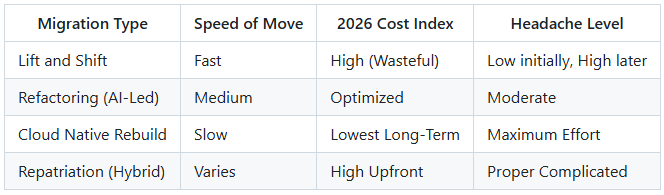
Nobody does simple lift and shift anymore unless they are desperate or lazy. Moving a mess to the cloud just gives you a cloud-based mess. And that mess is hella expensive to maintain in 2026.
Now, we are talking about "Refactoring 2.0." This is where AI actually helps us rewrite the code as we move it. It is like fixing the plane's engine while you are halfway across the Atlantic. Gnarly.
Speaking of which, mobile app development ohio is a good example of how regional hubs are now building cloud-first architectures right from the jump, rather than trying to fix them later.
💡 Corey Quinn (@quinnypig): "The cloud is just someone else's computer, but in 2026, that computer has a very aggressive collection agency attached to it if you misconfigure your S3 buckets." — Last Week in AWS
The Great Repatriation Myth
You might have heard the rumors. People saying they are leaving the cloud to go back to on-prem. I reckon that is mostly bark and no bite. Most "repatriation" is just moving to hybrid setups.
Sure, some folks are pulling certain workloads back to save a buck, but they are still keeping the heavy lifting in the cloud. It is about balance. You do not move back to a horse and carriage.
Thing is, your enterprise cloud migration services partner should be telling you this. If they are just pushing "all cloud all the time," they are probably trying to pad their own pockets. Fair dinkum.
View more: App Maintenance Fee: Costs & Factors (2026)
Hybrid Is the New Black
In 2026, the "all or nothing" approach is for amateurs. The pros are using distributed clouds. You keep the sensitive stuff close to home and the "bursty" stuff in the public hyperscalers. It is sorted.
But managing that? That is the hard part. You need a single pane of glass, or you will be jumping between consoles until you are cross-eyed. Nobody has time for that nonsense anymore.
The Sovereignty Problem
If you are operating in Europe or even parts of Asia, you cannot just dump data anywhere. Sovereignty is a massive deal now. You need "Local Zones" and "Sovereign Clouds" to stay legal.
I have seen projects get shut down overnight because some lawyer realized the customer data was sitting in a region it should not be. It is a proper mess if you do not plan ahead.
The Hidden Costs of Doing Nothing
Some managers think they are being clever by "waiting and seeing." But wait-and-see usually turns into "oh-crap-we-are-irrelevant." Your competitors are already using 2026-level cloud tools to outpace you.
The cost of maintaining that old data center is not just the electricity. It is the talent. Nobody wants to work on hardware that belongs in a museum. You will be stuck with a skeleton crew.
Real talk: the technical debt you are accruing is fixin' to bankrupt your agility. You are essentially paying "interest" on every single legacy system you refuse to move or modernize. It is a trap.
Finding the Right Help
Do not just hire the biggest name. Hire the team that actually understands your specific mess. You want people who have seen the "ugly" side of migrations and survived to tell the tale.
I have worked with "expert" consultants who could not find their way out of a paper bag without a PowerPoint deck. Avoid those folks like the plague. You need builders, not just talkers.
AI: The Migration Wingman
By now, AI agents are doing the heavy lifting in mapping dependencies. They can find that one random server in the corner that nobody has touched since 2014 but somehow runs the entire payroll.
Using these tools is not optional anymore. If your enterprise cloud migration services provider is doing everything manually, they are living in the past. You are paying for their inefficiency. That is dodgy.
💡 Werner Vogels (@werner): "In 2026, you don't build for the cloud; you build with the cloud. If you're still thinking about servers, you're missing the point of the programmable infrastructure." — All Things Distributed
"The shift toward industry-specific cloud platforms is accelerating, with 70% of enterprises using them by 2027 to speed up their specific business outcomes." — Max Rossi, Industry Analyst, Flexera 2025 Trends
The Future of Enterprise Cloud Shifts
Looking toward 2027, the focus is shifting toward "Sustainability Clouds." It is not enough to be fast; you have to be green. Boards are now demanding carbon footprint reports for every AWS or Azure region.
We are also seeing the rise of "No-Ops" environments where the cloud provider handles almost everything. It is a bit scary for traditional sysadmins, but it is where the smart money is going. Adapt or perish.
Data gravity is also pulling more compute to the edge. If your migration plan does not account for edge computing in 2026, you are building a centralized dinosaur in a decentralized world. Get with the program.
Wrapping This Mess Up
Look, I reckon the cloud is still the best place to be, despite the headaches. But you have to be smart about it. You cannot just throw money at the problem and hope for the best.
Get your FinOps sorted, embrace the hybrid reality, and for heaven's sake, use the AI tools available to you. It is the only way to stay sane in this high-speed 2026 environment.
If you are still struggling with enterprise cloud migration services, just remember: everyone else is probably faking it too. Just make sure you are faking it with a better plan than they have.


