Why the 2026 Housing Market is Basically a Math Problem
Real talk, I reckon everyone is tired of hearing how AI is going to save the world. It is 2026 and my fridge still cannot tell the difference between milk and a bottle of ranch. But the property market? That is different. The use of machine learning in real estate has moved from a fancy boardroom buzzword to the actual engine running the show.
If you are looking for a house today, you are not just fighting other buyers. You are fighting algorithms that have already crunched the numbers on every square inch of your neighborhood. It is hella intimidating, no cap. Data shows the PropTech AI market is fixin' to hit over $1.3 trillion by 2030, according to recent Grand View Research data. This is not some far-off dream, it is the reality of how we buy dirt in 2026.
Predictive Analytics: Beyond the Magic Ball
Remember when we used to guess which neighborhood would become the next big thing? Now, machine learning models look at everything from coffee shop opening dates to local school board permits. They predict price surges months before the first 'For Sale' sign even hits the yard. It is proper spooky how accurate these models have become.
Hyper-local Data vs. the Big Picture
The thing is, a national average is useless when you are trying to buy a bungalow in Austin or a flat in Glasgow. ML thrives on the tiny details. We are talking about foot traffic patterns and even local sentiment analysis from social media. If people are suddenly stoked about a new park, the algorithm knows before the local news does.
Property Valuation: Machines vs. Humans
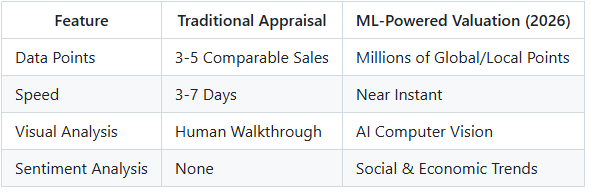
I used to think an appraiser with a clipboard was the gold standard. Boy, was I wrong. In 2026, Automated Valuation Models (AVMs) have become so refined that they make the old 'Zestimate' look like a child's drawing. These systems ingest millions of data points, including recent renovations detected via permits. This level of precision is exactly what teams like mobile app development arizona are building into modern real estate platforms for real-time tracking.
The 'Dodgy' Side of Algorithmic Pricing
But wait, it is not all sunshine and rainbows. There is a mildly cynical side to this. When every platform uses the same machine learning in real estate models, we get price synchronization. If the computer says a house is worth a million, everyone believes it. This can create a bit of a feedback loop that feels fair dinkum weird for actual humans trying to negotiate.
Image Recognition and Digital Staging
Get this, AI can now 'see' your kitchen. It analyzes listing photos to determine the quality of finishes. If you have stainless steel appliances and quartz countertops, the ML identifies them and adjusts the valuation automatically. It is brilliant for sellers but a bit of a nightmare if your house still looks like 1974.
Smart Investment Strategies: Not Just for Wall Street
You might think only the big banks have access to these toys. Wrong. In 2026, even the 'little guy' might could use ML-driven platforms to scout for undervalued assets. These tools highlight properties that are underperforming based on their zip code's potential. It is like having a crystal ball, but with more spreadsheets and less velvet.
Identifying Undervalued Assets Before the Hype
The goal is to find the 'hidden gems.' Machine learning looks for anomalies. Maybe a house is priced low because of a bad description, but the location and bones are perfect. The algorithm flags these faster than you can say 'fixer-upper.' It is a game-changer for anyone trying to build a portfolio without a massive team.
Risk Mitigation and Portfolio Diversification
Investing is always a gamble, but ML narrows the odds. By simulating thousands of economic scenarios, these models tell you how your portfolio will react to a rate hike or a local factory closure. It is about being sorted before the storm hits. Most people are still guessing, but the smart money is moving toward data-backed decisions.
"The integration of machine learning isn't just about faster calculations; it's about uncovering the 'why' behind market movements that remain invisible to the human eye." — Glenn Kelman, CEO of Redfin, Redfin News & Reports
View more: Machine learning in logistics.
The Future: What is Hiding in 2027?
The next year is fixin' to be even wilder. We are seeing signals that machine learning in real estate will move toward predictive maintenance for homeowners. Imagine your house telling you the HVAC is going to die three weeks before it actually happens. Market analysts expect a shift toward hyper-personalized search, where the algorithm knows you need a home office with specific lighting before you even type a query. Based on reports from PwC, the adoption of generative AI for virtual renovations will become the standard for every single listing by mid-2027.
Sustainability and Predictive Maintenance
Buildings are getting smarter. ML now monitors energy consumption patterns to suggest upgrades that actually pay off. It is not just about being green; it is about saving money. This is especially true in older cities where retrofitting is a massive puzzle. Data is the only way to solve it without going broke.
Hyper-Personalized Buyer Experiences
I reckon we are done with scrolling through 500 bad listings. By 2027, the app will just show you the three houses you actually want. It learns your style, your commute tolerance, and even your preference for local breweries. It is almost like the app knows you better than you know yourself, which is a bit gnarly if you think about it too long.
💡 Spencer Rascoff (@spencerrascoff): "PropTech in 2026 is no longer about listing homes; it's about the data-driven certainty of the transaction itself." — X/Twitter Insights
💡 Julie Taylor: "If your real estate strategy doesn't involve a predictive model by now, you aren't just behind; you're effectively invisible in this market." — NAR Industry Commentary
The Human Element in a Tech-Driven World
Here is the thing, even with all this tech, you still need a human to tell you if the neighborhood 'feels' right. A machine can track the crime rate, but it cannot tell you if the neighbors are loud at 2 AM or if the local coffee shop has a proper vibe. We are in a weird middle ground where we need the math, but we still crave the gut feeling.
So, is the use of machine learning in real estate a good thing? I reckon it depends on which side of the transaction you are on. If you have the data, you are king. If you don't? Well, you are just another person getting outbid by a bot. It is a brave new world, and it is honestly a bit knackered if you aren't prepared to play by the new rules.


