The Brutal Truth About App Longevity in 2026
You probably think you’re finished once your app hits the store. That is a massive mistake. Building an app is like getting a puppy; the birth is the easy part, but the next ten years are fixin' to be a lot of work. Real talk, most apps die within six months because the owners treat them like a static website from 1999.
In 2026, the mobile ecosystem is moving faster than a Sydney commuter catching the last ferry. If you aren't updating, you are decaying. Users have zero patience for lag or broken buttons. They will delete your hard work faster than you can say "no worries."
The "Set It and Forget It" Myth
Let me explain why your "finished" app is actually a ticking time bomb. Operating systems like iOS 19 and Android 17 are constantly shifting their architecture. What worked yesterday is likely to be knackered by tomorrow morning. It’s a relentless cycle of keeping up or getting left behind.
You might reckon that a few bug fixes here and there are enough. They aren't. Maintenance isn't just about fixing what’s broken; it's about staying relevant in a market that is hella crowded. Statistics from Statista (2025) show that millions of apps are removed annually for lack of updates.
Why Users Ghost Your App
Thing is, user expectations have shifted. In 2026, if an app takes more than 1.5 seconds to load, people assume it’s broken. We’ve become spoiled by instant gratification. If your maintenance schedule doesn't include performance tuning, you're essentially ghosting your own audience.
Your users are the best QA team you’ll never pay. When they complain about a glitch, they’re giving you a roadmap to survival. Ignoring them is the fastest way to see your retention numbers tank. It’s proper dodgy to ask for their data and then give them a buggy experience in return.
Infrastructure Maintenance: The Engine Room
Most of the work happens where no one sees it. Your backend, your APIs, and your server configurations are the heavy lifters. If the engine room is a mess, the shiny UI doesn't matter one bit. You have to keep the pipes clean and the gears greased.
Cloud costs can spiral out of control if you aren't paying attention. Regular audits of your AWS or Azure usage are mandatory. I've seen startups go broke because they left a test environment running for three months. That’s all hat and no cattle, as we say in Texas.
Managing Technical Debt
Every time you take a shortcut during development, you’re signing a high-interest loan. Eventually, the debt collector comes knocking. Technical debt is the silent killer of great apps. It makes every new feature harder and more expensive to implement.
Refactoring code should be a regular part of your sprint cycle. It's not glamorous, but it’s how you stay agile. A good example of this is seen with a mobile app development company ohio where they prioritize clean architecture to avoid long-term bottlenecks. You can't build a skyscraper on a swamp.
Security Patches and Protocol Updates
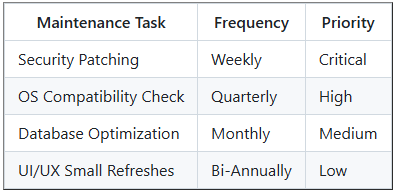
Security isn't a one-time thing. Hackers in 2026 are using AI-driven tools to find vulnerabilities in record time. If you aren't patching your dependencies every week, you’re basically leaving your front door wide open. It’s a scary reality, but someone has to say it.
Data privacy laws are also evolving. What was legal last year might get you a massive fine this year. Maintaining your app means keeping your legal team in the loop as much as your developers. Don't be the person who loses everything over a preventable data breach.
"Maintenance is not a cost center; it is a retention strategy. The most successful apps in 2026 are those that treat their codebase as a living organism that requires constant nourishment." — Andrew Chen, General Partner at a16z
Performance Optimization: The Need for Speed
Speed is a feature. In fact, it might be the most important feature you have. If your app feels sluggish, it feels old. And in 2026, old is a death sentence. You need to be obsessed with frame rates and latency.
Heavy images and unoptimized scripts are the usual suspects. You’d be surprised how much junk accumulates in an app over a year of "quick fixes." It’s like a digital attic that needs a proper spring cleaning every few months.
Monitoring Real User Metrics (RUM)
Stop relying on "it works on my machine." You need data from the wild. Real User Metrics tell you how the app performs on a cheap phone in a basement with bad Wi-Fi. That is where the real battle is won or lost.
Tools like Sentry and New Relic are your best mates here. They catch the crashes before the angry emails start rolling in. If you aren't monitoring in real-time, you're just guessing. And guessing is a terrible business strategy for 2026.
💡 Gergely Orosz (@GergelyOrosz): "The hallmark of a mature engineering team isn't how fast they build new features, but how rigorously they maintain the old ones." — The Pragmatic Engineer
Database Health Checks
As your user base grows, your database can become a bottleneck. Queries that were fast with 1,000 users will crawl with 100,000. Indexing, sharding, and caching are your secret weapons to keep things moving smoothly.
Don't wait for a total outage to check your logs. Regular health checks can spot a failing query before it brings down the whole system. It's much cheaper to fix a slow query than to explain to investors why the app was down for six hours.
💡 Naval Ravikant (@naval): "Code is the most efficient form of leverage, but only if you keep it functional. Broken code is just expensive prose." — Naval.com
Content and UI Refreshes
An app that looks the same for three years feels abandoned. You don't need a total redesign, but small, iterative UI improvements keep the experience fresh. It shows the users that someone is still home and they still care.
Color palettes and typography trends change. Even the way we use our thumbs on larger screens evolves. If your navigation menu is still stuck in 2022, your users will feel it. It’s about the vibe as much as the function.
A/B Testing New Features
Never assume you know what the users want. Test it. Maintenance includes the constant cycle of trying new things and killing what doesn't work. It’s better to remove a feature that no one uses than to keep supporting it forever.
Bloatware is the enemy. Every feature you add increases the maintenance burden. Sometimes, the best maintenance you can do is to delete code. It makes the app lighter, faster, and easier to manage. Be ruthless with your own creations.
User Feedback Integration
Read your reviews. Yes, even the one-star ones from people who are clearly having a bad day. There is usually a kernel of truth in the complaints. If ten people say the checkout is confusing, the checkout is confusing.
Respond to your users. Let them know a fix is coming. This builds a community of loyalists who will stick with you even when things aren't perfect. In 2026, brand loyalty is harder to earn than ever, so don't throw it away.
View more: how to maintain an app
The Cost of Maintaining an App
Let's talk money. Maintenance usually costs about 15% to 20% of your initial development budget every single year. If you spent $100,000 to build your app, expect to pay $20,000 a year just to keep the lights on. That’s just the cost of doing business.
If you don't budget for this, you're fixin' to have a bad time. Many founders blow their whole budget on the launch and then wonder why the app is broken six months later. Don't be that person. Budget for the marathon, not the sprint.
"The real cost of software is not the initial build, but the long-tail maintenance. If you aren't prepared for the 10-year lifecycle, don't start." — Martin Fowler, Chief Scientist at Thoughtworks
In-House vs. Outsourced Maintenance
Should you keep your devs on staff or hire a firm? It depends on your scale. In-house teams have deep context but can be pricey. Outsourcing is great for specialized tasks or seasonal updates. Both have their pros and cons.
The key is consistency. You can't have a new team every six months trying to figure out the old team’s "clever" code. Pick a partner or a team and stick with them. Long-term knowledge is the best insurance policy against system failure.
Third-Party API Fees
Most apps are a collection of third-party services. Maps, payment gateways, and push notifications all cost money. And those prices change. Part of maintenance is reviewing your vendor contracts to make sure you aren't overpaying.
Sometimes a service goes out of business or changes its API significantly. You need a plan for when that happens. Relying too heavily on a single external service is a risk. Always have a backup plan, or at least be ready to pivot quickly.
Future Trends: Maintenance in 2026 and Beyond
We are entering the era of "Self-Healing Code." AI agents are now being used to monitor logs and automatically write PRs to fix common bugs. While we aren't at 100% automation yet, the burden on human developers is starting to shift. In 2026, the focus is moving from manual bug hunting to high-level system architecture. According to Gartner (2025), AI-driven development is expected to reduce maintenance workloads by 40% by 2027. We’re also seeing a massive push toward "Edge Computing" for app backends, which reduces latency but adds a new layer of maintenance complexity in distributed systems.
Automated Regression Testing
If you're still testing manually, you're living in the stone age. Automated testing is the only way to ensure that a fix in one area doesn't break three things in another. It’s about peace of mind. You should be able to push an update on a Friday afternoon without a panic attack.
Continuous Integration and Continuous Deployment (CI/CD) pipelines are standard now. They catch errors before they ever reach a user's device. If your maintenance workflow doesn't include a robust pipeline, you're playing a dangerous game. It's time to level up.
Predictive Analytics for Maintenance
In 2026, we don't just react to crashes; we predict them. By analyzing patterns in server load and user behavior, we can see a failure coming hours before it happens. This allows for proactive maintenance that keeps the app live 99.99% of the time.
This kind of foresight is what separates the pros from the amateurs. It requires a bit more investment upfront, but the savings in avoided downtime and lost revenue are massive. It’s the smart way to handle a growing digital product.
Wrapping Up the Maintenance Marathon
Maintaining an app is a grind, no doubt about it. It’s less about the "Big Launch" and more about the thousand tiny improvements you make every week. But that’s how you build something that actually lasts. You have to stay stoked about the boring stuff.
Whether you're fixin' to update your security protocols or just cleaning up some dodgy code, remember that your app is a reflection of your brand. Keep it fast, keep it safe, and for heaven's sake, keep it updated. Your users will thank you, and your bank account will too. No worries, y'all—you've got this.


