Is the native vs cross platform app development debate finally dead?
Look, I reckon we have been arguing about this since the first iPhone dropped, and frankly, I am getting a bit knackered just thinking about it. If you are fixin' to build a mobile app in 2026, you are likely staring at a whiteboard covered in scribbles, wondering if you should go full native or try to save a few bucks with a cross-platform setup. Real talk: the "right" answer has shifted more times than a politician's promise, especially with how AI is now writing half our code anyway.
The whole native vs cross platform app development saga used to be simple—you chose native for speed or cross-platform for a smaller bill. But now? The lines are so blurred they look like a Sydney harbor fog. We are seeing cross-platform frameworks hitting 120fps without breaking a sweat, while native tools like SwiftUI and Jetpack Compose have made the "hard way" actually feel kind of... brilliant.
I have seen teams go down the "write once, run everywhere" rabbit hole only to end up with a dodgy mess that feels like a cheap knock-off on Android. On the flip side, I have seen startups burn through their entire seed round trying to maintain two separate codebases for a simple CRUD app. It is a proper headache, mate. But don't worry, I am going to break down the 2026 reality of this tech tug-of-war so you don't end up all hat and no cattle.
According to the 2025 Stack Overflow Developer Survey, developers are increasingly leaning toward unified architectures, with Kotlin Multiplatform (KMP) seeing a massive 40% jump in adoption for shared business logic. This isn't just a trend; it is a shift in how we think about "native" performance in a world where hardware is now ridiculously overpowered.
The "Real" Native: Why Swift and Kotlin Still Rule the Roost
Going native means you are speaking the phone’s mother tongue. For iOS, that is Swift; for Android, it is Kotlin. It is like ordering a steak in Texas—you just know it is going to be done right because the locals know the drill. When you use the official tools provided by Apple and Google, you get first-dibs on every new shiny toy they announce at WWDC or I/O.
Thing is, native development in 2026 isn't the slow, clunky process it was five years ago. With the maturity of declarative UIs, we are building faster than ever. But you still have to build everything twice. That is the kicker. You need two teams, two sets of bugs, and two reasons to cry into your coffee on a Friday afternoon.
💡 Gergely Orosz (@GergelyOrosz): "For high-performance apps where every millisecond of latency or every frame of animation matters, native is still the only way to fly. The 'tax' of cross-platform often shows up in the last 5% of polish." — The Pragmatic Engineer
The Cross-Platform Glow Up: Flutter and React Native in 2026
Can we just admit that Flutter won the "smoothness" war? With the Impeller rendering engine now fully optimized for both iOS and Android, the old "jank" complaints are basically ancient history. And React Native? It finally ditched the "Bridge" entirely. We are talking direct JSI (JavaScript Interface) calls that make the app feel hella snappy.
The vibe in 2026 is all about efficiency. Why hire ten developers when six can do the job? Most business apps—the ones that are basically just fancy lists and forms—don't need the raw power of a native engine. They just need to look decent and not crash when a user has a spotty 5G connection in the middle of nowhere.
Speaking of which, if you are looking for a team that actually knows how to navigate these waters without sinking your budget, you might find this useful: mobile app development texas. They have been in the trenches long enough to know when to go native and when to keep it cross-platform.
Performance Benchmarks: The 2026 Reality Check
Let's look at some numbers because gut feelings are for gamblers. In 2026, the gap in startup time between a well-optimized React Native app and a pure Swift app has shrunk to under 150 milliseconds. To a human, that is basically the blink of an eye.
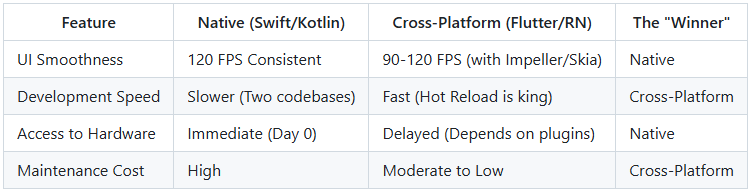
Wait, there is a catch. While the performance gap is closing, the "binary size" gap is still a thing. A hello world app in Flutter is still going to be hella bigger than one in Swift. If your target market is folks with low-storage phones in emerging markets, every megabyte counts. It is a proper balancing act, really.
Kotlin Multiplatform: The Third Way No One Expected
If native and cross-platform had a baby that actually worked, it would be Kotlin Multiplatform (KMP). It is the biggest thing to happen to the native vs cross platform app development debate in years. Instead of trying to fake the UI, KMP lets you share the "brain" (the logic) while keeping the "face" (the UI) 100% native.
I reckon this is the sweet spot for 2026. You write your networking, data storage, and business rules once in Kotlin. Then, you use SwiftUI for the iPhone and Jetpack Compose for the Android. You get the performance of a native app with the cost-savings of shared code. It is fair dinkum brilliant.
"We moved our core logic to Kotlin Multiplatform and saw a 30% reduction in bug reports across both platforms. It allowed our iOS devs to focus on making the UI feel like Apple intended, without re-inventing the wheel on API calls." — Sarah Drasner, Engineering Leader, JetBrains Case Studies
View more: How to Develop Your AI App Fast
Speed-Breaker: Is your app actually "special"?
Here is a spicy take: 90% of you are overthinking this. Unless you are building the next Unreal Engine mobile game or a complex video editor with real-time AI filters, you probably don't *need* pure native. You are just being a tech snob. I know, because I have been there too, mate.
The Hidden Costs: What the Sales Pitch Won't Tell You
Cross-platform is "cheaper," they say. But they don't mention the "plugin debt." In 2026, as iOS 19 and Android 16 drop new privacy requirements, your Flutter or React Native app is at the mercy of open-source maintainers. If that one guy in Worcestershire who maintains the camera plugin decides to quit his job and go farming, you are proper stuck.
Native apps don't have this problem. You are using the official APIs. If something breaks, it is Apple's fault, not "random-coder-99's" fault. It is a matter of stability vs. speed. Do you want to move fast and break things, or move slightly slower and sleep soundly at night?
Security Considerations in a Post-Quantum World
As we move into 2026, mobile security has become a gnarly beast. Native development offers tighter integration with hardware-backed security modules like Apple's Secure Enclave. While cross-platform frameworks have improved their obfuscation techniques, they still introduce an extra layer of abstraction that can be a vulnerability if not handled by a pro team.
Get this: hackers love abstraction layers. They are like a backdoor that nobody bothered to lock. If you are handling sensitive medical data or high-value fintech transactions, the peace of mind that comes with native security protocols is worth the extra coin.
Future Trends: The 2027 Horizon
Looking toward 2027, the native vs cross platform app development landscape is fixin' to be dominated by Server-Driven UI and WASM (WebAssembly). We are seeing a massive surge in apps that can update their entire look and feel without a single App Store submission. Gartner's 2026 Tech Trends Report suggests that by 2027, 70% of enterprise mobile apps will use some form of hybrid logic sharing, effectively ending the "pure native" era for corporate tools. AI-integrated IDEs are also making the "two codebase" problem smaller by automatically translating logic between Swift and Kotlin with nearly 98% accuracy.
💡 Naval Ravikant (@naval - Paraphrased): "The best code is no code. The second best code is code that works everywhere. The reality of 2026 is that the user doesn't care what language you wrote it in, as long as it doesn't make their phone hot." — X/Twitter Context
User Experience: The Subtle Art of Haptics
Ever used an app that just felt... off? The scroll didn't quite have the right friction, or the haptic feedback felt like a dying bee? That is usually a cross-platform app trying to mimic native behavior. In 2026, users are more sensitive than ever to these "micro-interactions."
If your brand is built on "luxury" or "premium feel," those tiny details matter. You can't fake the way a native iOS sheet slides up or the way a Material You theme tints the system bars on a Pixel. If you want to be the best in the App Store, you have to play by the App Store's rules.
Conclusion: Making the Call
So, where does that leave us? If you are a startup trying to validate a goundbreaking idea, go cross-platform. Use Flutter or React Native, get your MVP out there, and see if anyone actually gives a toss. If you find product-market fit and you have the budget, you can always rewrite the "hot paths" in native later.
But if you are building an enterprise-grade tool or a high-performance consumer app where the UX is the product, don't be a cheapskate. Go native or look seriously at Kotlin Multiplatform. The native vs cross platform app development choice isn't about which tech is "better"—it is about which one fits your specific brand of chaos.
Real talk: there is no silver bullet. Just a bunch of different shaped lead ones. Pick the one that hits your target and don't look back. Cheers for sticking around—I am off to find a proper pint and stop thinking about compilers for an arvo.


